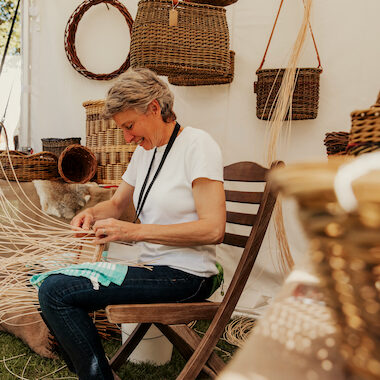
Marianne van Niekerken – Crafty Basketry
Cranbrook, Kent, TN18 BiographyMarianne van Niekerken is a Dutch basketmaker based in Newenden, Kent, on the Kent and East Sussex border. Working primarily with willow grown on her own plots, she also explores the qualities of dogwood, hazel and sweet chestnut, creating baskets that combine traditional techniques with a contemporary approach to form, texture and colour.
Having made her first basket in 2006, Marianne has developed an evolving practice that continues to explore the possibilities of basketry. She has been teaching since 2018, sharing her skills and experience with both beginners and more established makers.
You may know Marianne through Crafty Basketry. The name remains part of her story, but her work now sits under her own name, reflecting the direction her practice has taken. Her baskets have become increasingly experimental, with a growing interest in rare heritage techniques that are on the endangered list, finer structures and intricate detail. Her teaching has developed alongside this, with workshops designed to help makers deepen their understanding and extend their skills.
How I Began
In 2006, while working as a personal assistant in the corporate world, I booked a two-day basketry course with Alan Sage, a woodsman and teacher of Autistic children. I had little idea what to expect, but something about the prospect of making with natural materials appealed to me. The experience took me straight back to childhood holidays in the green, rural east of Holland: time spent outdoors, making things and exploring the woods, surrounded by the familiar smells of damp earth, fungi and fallen leaves.
Two days, one rather modest basket and a fair number of mistakes later, I was completely captivated. More than that, I had discovered a way of working that brought a sense of calm and concentration I hadn't realised I was missing. I returned for another course, this time working with hedgerow materials, and what began as a hobby gradually became my full-time occupation.
What continues to draw me to basketry is the combination of making, problem-solving and working closely with natural materials. There is always something new to discover, and no two materials or baskets are quite the same.
Why Willow
Growing up in Holland, I was surrounded by basketry. Woven willow and rattan were part of everyday life, appearing in furniture, storage and household objects. Influences from Scandinavia and Indonesia were woven into the domestic landscape, and natural materials brought warmth, texture and character into the home. Objects were made to be used, cared for and kept.
That relationship with useful, lasting objects remains important to my own work. Sustainability is not an added consideration; it is part of the way I approach making. I favour natural materials, traditional skills and objects that are intended to last. I also provide care advice so that baskets can be looked after and enjoyed for many years.
Much of my willow is grown close to home, in Newenden and on two further plots in Sedlescombe and Burwash. The oldest of these beds was planted around fifteen years ago, while the newest is now four years established. Willow is a remarkable crop, with vigorous roots that can reach several metres into the ground.
I grow without pesticides or herbicides, keeping the plots relatively small, at around half an acre each. This helps me manage the crop and maintain a balance with the surrounding environment. Every rod is cut, dried, sorted and graded by hand. This gives me an intimate understanding of the material before it reaches the workshop. I particularly enjoy the unusual rods: the forked, twisted and awkwardly shaped pieces that might be overlooked by others but offer interesting possibilities in their own right.
Willow has a valuable place in the landscape as well as in the workshop. Its early catkins provide an important source of pollen for insects, its beds offer shelter for wildlife, and its extensive root systems help stabilise soil and contribute to water management, as well as filters ground water from toxins. Even its bark has a long history of use; it contains salicin, a compound that helped inspire the development of aspirin.
In Holland, willow has long played an essential role in managing water and protecting the land. Much of the country lies below sea level, and willow has traditionally been used to reinforce dykes and protect vulnerable coastlines. Woven into long, broad mats, it helped defend beaches against erosion, while its use in drainage and water management stretches back centuries.
This practical heritage is part of what makes willow so fascinating to me. It is a material with a rich history, deeply connected to the landscape and to people's everyday lives, yet it continues to offer endless possibilities for contemporary making.
Please take a look at my brand new website, which will reflect the changes in my work over time.
Interests- Pine Needles
- Skep Making
- Basketry
- Cane (Basketry)
- Contemporary
- Garden Structures
- Hedgerow
- Natural Fibres
- Skeined Willow (Basketry)
- Splint Wood / Oak
- Traditional
- Willow (Basketry)
Gallery


